Most enterprises don’t have a data shortage. They have a data-access problem.
Somewhere in your organization, the numbers that could answer your most urgent business questions already exist, buried inside a CRM that doesn’t talk to your data warehouse, a legacy reporting tool running on a separate server, and a spreadsheet your finance team exports manually every Monday morning. The intelligence is there. The problem is that it’s trapped.
Gartner research estimates that poor data quality costs organizations at least $12.9 million per year on average. And the cost isn’t just financial. It’s strategic. When data lives in silos, decision-makers can’t trust what they’re seeing. Or worse, they don’t know what they’re missing.
What Fragmented Data Actually Looks Like
Picture a mid-sized financial services organization with four separate systems, each deployed at different times, by different vendors, for different purposes. None of them were designed to communicate with each other. Every week, analysts spend hours pulling reports from each system, reconciling field definitions that don’t quite match, and aggregating data in spreadsheets that introduce new opportunities for human error. By the time the executive dashboard is ready Monday morning, the underlying data is often 48 to 72 hours old, and the decisions made from it reflect that lag.
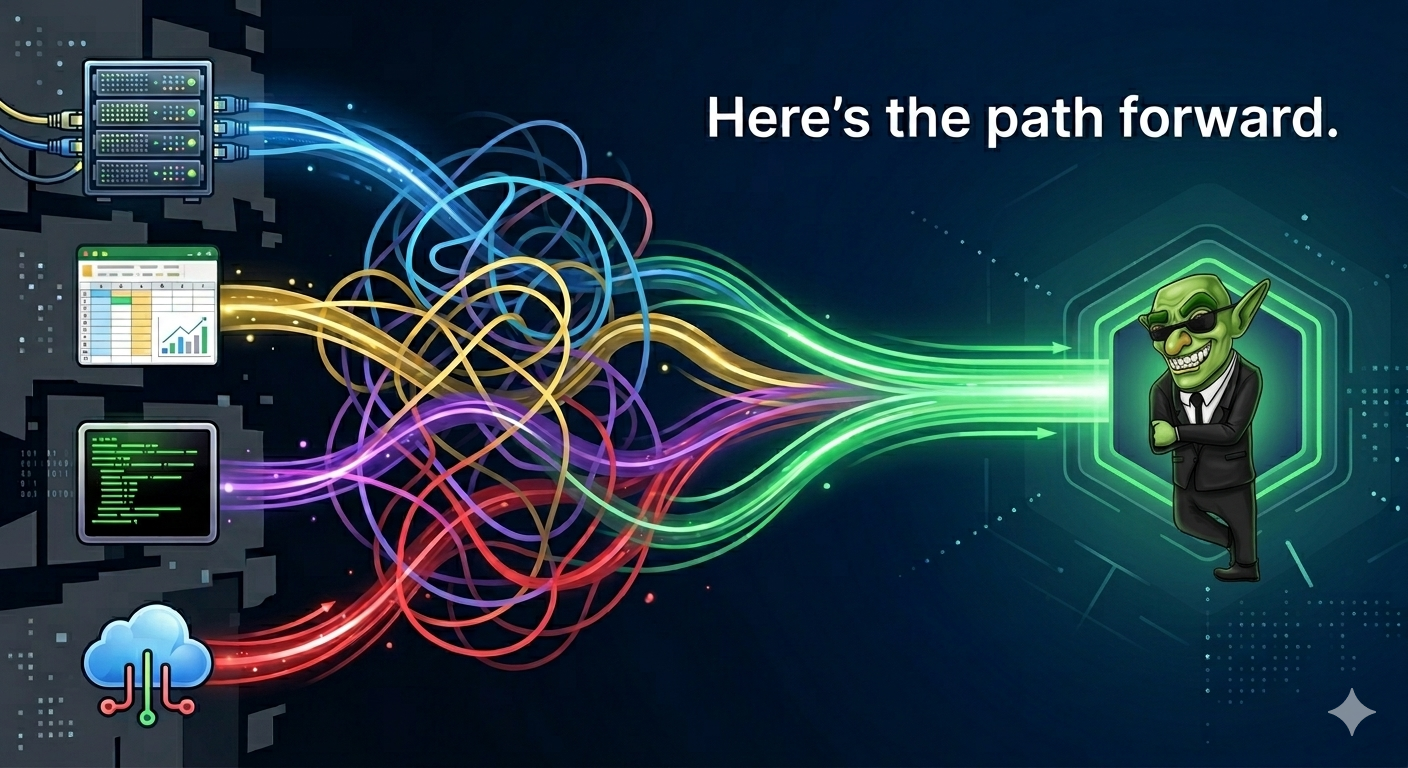
This is a scenario Predictive Analytics Group encounters repeatedly across financial services. In one real-world engagement, a mid-sized fintech came to PAG needing to launch a new card program with data scattered across four separate streams. Without consolidation, building an underwriting strategy would have been a months-long undertaking. Instead, GOBLIN merged and automated all four data streams, enabling the PAG team to build an initial underwriting strategy and a robust executive monitoring suite, ready for review from day one.
The inefficiency compounds over time. Teams that should be analyzing are instead cleaning, translating, and manually assembling data. The insight generation that leadership actually needs gets pushed downstream or never happens at all.
How AI Changes the Consolidation Equation
Consolidating enterprise data used to mean months of custom development, manual field mapping, and fragile integrations that broke whenever a source system got updated. AI has changed that math.
Modern AI-driven platforms use machine learning to automatically identify and map data fields across systems (Salesforce, Oracle, SAP, legacy databases, you name it) and flag data quality issues in real time, before they corrupt downstream analytics. Organizations don’t just consolidate faster. They consolidate more accurately than manual processes ever allowed.
The most reliable AI-powered data environments aren’t fully automated. They keep experienced data professionals at key decision points in the pipeline. A low-risk analytics dashboard may run without human involvement. But a decision to approve a high-value loan or flag a portfolio anomaly should have a qualified expert in the loop, with that interaction logged, reviewed, and auditable.
This is the model GOBLIN is built around. PAG’s DBAs and developers aren’t replaced by AI; they’re accelerated by it across every layer of the platform, from real-time infrastructure diagnostics to code optimization to automated compliance documentation.
From Consolidation to Strategic Advantage
When consolidation is done right, the transformation is tangible. Leadership stops waiting for Monday morning reports and starts querying live data. Analysts stop reconciling spreadsheets and start building models. Compliance teams stop chasing documentation and start reviewing automated audit trails.
Consolidation isn’t just an operational improvement. It’s the prerequisite for every AI initiative on your roadmap. MuleSoft’s 2025 Connectivity Benchmark Report found that 95% of IT leaders report integration hurdles as their primary barrier to AI implementation, and that only 28% of enterprise applications are currently connected. The consolidation problem and the AI ambition are not separate challenges. They’re the same challenge.
Put simply: if your data consolidation is broken, your AI strategy is broken too.
Microsoft has described this as an “AI data readiness gap,” noting that most legacy data ecosystems were designed for reporting rather than the kind of continuous reasoning that modern AI requires. The organizations closing that gap are the ones building on the right foundation now.
When an investment company came to PAG needing to evaluate a complex portfolio acquisition, GOBLIN didn’t just consolidate the data. The platform developed multiple forecasting models to support the due diligence process, recommended optimum portfolio pricing across product lines, and surfaced dataset discrepancies that helped the client ask better questions of the seller.
That’s not a data management story. That’s a strategic decision story. And it starts with getting the data into one place.
What to Do Next
Evaluate your consolidation readiness with these four questions:
- How many separate systems does your team pull from to build a standard executive report?
- What percentage of your analysts’ time is spent on data preparation versus actual analysis?
- Do different departments regularly produce reports with different numbers for the same metric?
- If your most critical legacy system went offline tomorrow, how long would it take to restore normal operations?
If the answers make you uncomfortable, you’re not alone. And you’re not stuck.
Predictive Analytics Group helps clients cost-effectively bridge the gap between analysis and impactful strategic or tactical decisions. To learn more about how GOBLIN can consolidate your data environment and accelerate your AI readiness, schedule a discovery call with us.