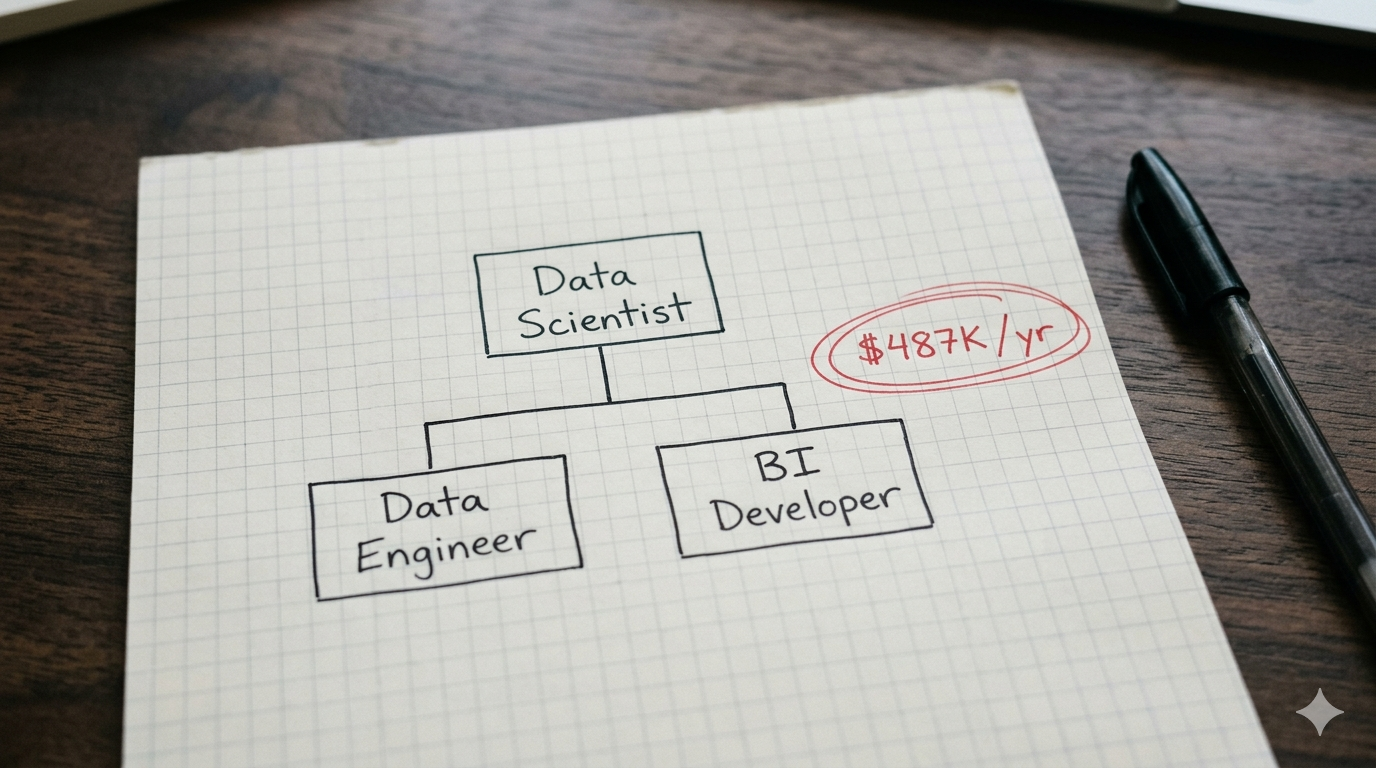
The CFO of a specialty lender had a hiring plan on her desk. Three seats in total, a data scientist, a data engineer, and a BI developer, fully loaded at $487,000 in year one. Her Chief Credit Officer had been asking for predictive delinquency models for 18 months. Her CEO wanted real-time portfolio dashboards. Her head of collections wanted segmentation that didn’t require a weeklong SQL request every time someone asked a new question.
The hiring plan promised all of it, starting about nine months after the first offer letter, assuming the offers got accepted. She’d been trying to fill the data scientist seat alone for six months. The only candidate who’d said yes had called back two weeks later to take a counter from a fintech in Austin.
Leadership wants faster answers, sharper portfolio monitoring, and the kind of predictive intelligence that used to live only at banks with eight-figure analytics budgets. Someone at the table says, “We need to hire a data science team.” Heads nod. A hiring plan starts circulating.
That plan is the problem. Not because data science doesn’t matter, but because the headcount-first path is broken, and most mid-market financial services companies don’t realize it until they’re six months and several hundred thousand dollars deep.
The Talent Math Doesn’t Work
According to the World Economic Forum’s Future of Jobs Report 2025, AI and Machine Learning Specialists are the fastest-growing roles globally, yet 63% of employers report that a lack of skilled talent is the single biggest barrier to their business transformation.
Even when you find someone, the cost compounds fast. The U.S. Bureau of Labor Statistics puts the median annual salary for a data scientist at around $112,590, and senior practitioners with FS specializations routinely clear $150,000 before benefits, tooling, or the months of ramp time before they produce anything useful. A small team of three (a data scientist, a data engineer, and a BI developer) runs $400,000 to $500,000 fully loaded in year one, before a single underwriting model gets built or a single collections strategy gets optimized.
Then there’s retention. The same talent scarcity that makes hiring hard makes keeping people more difficult. Strong analytics talent doesn’t stay long in environments with fragmented data, slow tooling, or limited upward mobility, which is precisely the environment most mid-market financial-services (FS) companies would be hiring them into.
“Add a data scientist to that environment and you’ve just paid $150,000 for someone to wrangle spreadsheets.”
The Real Problem Is Infrastructure, Not Headcount
The actual goal was faster decisions, better segmentation, proactive portfolio monitoring, and predictive modeling you can act on.
They require the right infrastructure. We wrote recently about why most AI strategies stall at the data layer. The same principle applies here. Industry benchmarks widely cite that analysts spend up to 70 percent of their time cleaning and assembling data rather than analyzing it. Add a data scientist to that environment and you’ve just paid $150,000 for someone to wrangle spreadsheets. The right platform flips the equation. It handles data management automatically, so the analytical work can move at the speed the business requires.
What “Advanced Analytics” Actually Means
Analytics is a progression across four levels, each answering a more valuable question than the last:
| Level | The Question It Answers | What It Costs Without a Platform |
| Descriptive | What happened? | BI developer plus regular reporting cycles |
| Diagnostic | Why did it happen? | Data analyst plus manual investigation |
| Predictive | What’s likely to happen next? | Data scientist plus ML model development |
| Prescriptive | What should we do about it? | Senior data scientist plus ongoing model refinement |
Most mid-market FS companies are stuck at descriptive. Weekly reports. Monthly dashboards. Backward-looking summaries that tell leadership what already happened, 48 hours after it stopped mattering. Moving up the ladder the traditional way means three to four new hires and 12 to 18 months of buildout before the first production model ships.
A platform that runs all four levels natively on your consolidated data collapses that timeline to weeks.
What GOBLIN Delivers Instead
GOBLIN was built for exactly this scenario. The platform bridges the analytics gap by design, delivering advanced analytics outcomes without staffing them in-house.
It consolidates fragmented FS data (originations, servicing, collections, portfolio, and third-party) into a single, AI-ready source of truth. The platform’s AI interprets complex data patterns automatically, runs predictive modeling to surface segmentation and portfolio opportunities, and delivers all four levels of analytics on the same environment. The reporting suite is SOC2-compliant with granular access controls, so the right people see the right data without opening a ticket.
PAG operates the platform on your behalf. Reports show up on schedule. Segmentation questions get answered the same day they’re asked. A portfolio acquisition gets evaluated in two weeks instead of two months. The team behind GOBLIN doesn’t fall behind the market because they’re using the same AI acceleration they’re delivering to clients.
When an investment company came to PAG needing to evaluate a complex portfolio acquisition, GOBLIN didn’t just provide data. The platform developed multiple forecasting models, recommended optimum portfolio pricing across product lines, and surfaced dataset discrepancies that sharpened the client’s due diligence process. That’s prescriptive analytics, the highest and most valuable level, delivered without a single data scientist on the client’s payroll.
The Question You’re Actually Asking
The question was never whether your organization needs advanced analytics. It does. The question is whether the path to getting there runs through a 12-month hiring process and a half-million-dollar annual team you’ll struggle to retain, or through the right platform, deployed now.
Predictive Analytics Group helps financial services companies bridge the gap between analysis and action. To see what GOBLIN can do for your portfolio without adding headcount, schedule a 30-minute demo.